Innovate closed-loop brain stimulation technology using Machine Learning
My current research focus is the development of a clsed-loop brain stimulation framework to induce desired brain states. I leverage machine learning to innovate the brain stimulation technology for novel treatment development as well as scientific discovery.
Projects
NeurIPS 2025
Sep 2024 – May 2025
Sep 2024 – May 2025
OMiSO: Adaptive optimization of state-dependent brain stimulation to shape neural population states
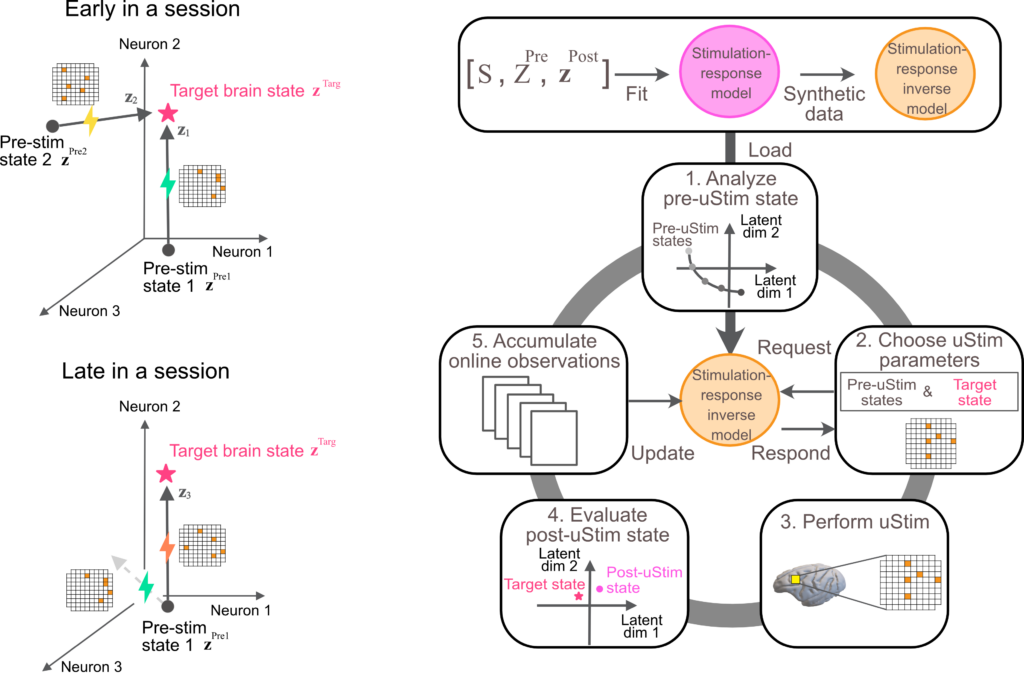
To improve the accuracy by which one can manipulate neural activity, it is important to (1) take into account the pre-stimulation brain state, which can influence the brain’s response to stimulation, and (2) adaptively update stimulation parameters over time to compensate for changes in the brain’s response to stimulation. In this work, we propose Online MicroStimulation Optimization (OMiSO), a brain stimulation framework that leverages brain state information to find stimulation parameters that can drive neural population activity toward specified states. OMiSO includes two key advances: i) training a stimulation-response model that leverages the pre-stimulation brain state, and inverting this model to choose the stimulation parameters, and ii) updating this inverse model online using newly-observed responses to stimulation. OMiSO provides greater accuracy in achieving specified activity states than MiSO, thereby advancing neuromodulation technologies for understanding the brain and for treating brain disorders.
NeurIPS 2024
Sep 2021 – May 2024
Sep 2021 – May 2024
MiSO: Optimizing brain stimulation to create neural population activity states
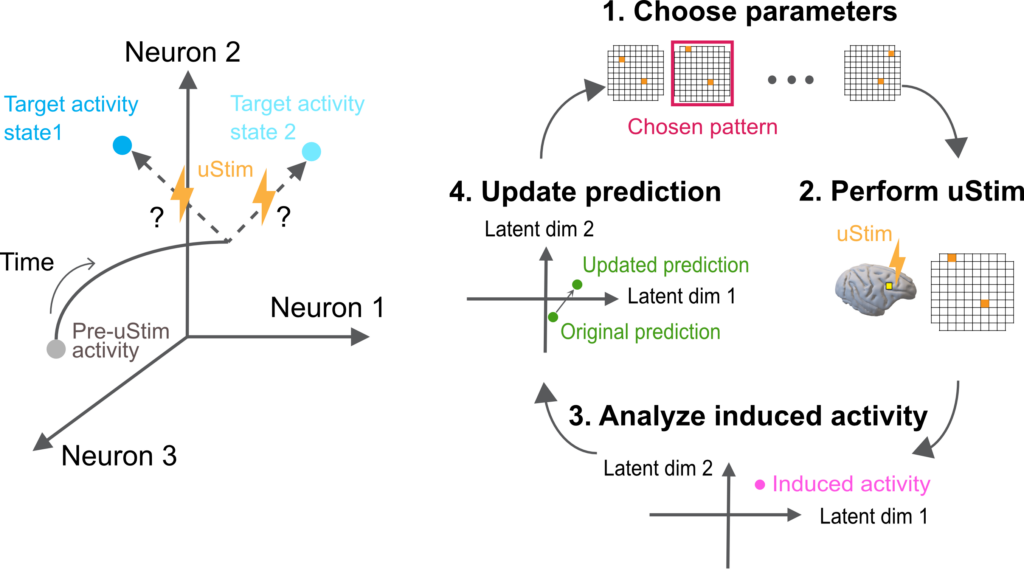
Brain stimulation has the potential to create desired neural population activity states. However, it is challenging to search the large space of stimulation parameters, for example, selecting which subset of electrodes to be used for stimulation. To address this challenge, we develop MiSO (MicroStimulation Optimization), a closed-loop stimulation framework to drive neural population activity toward specified states by optimizing over a large stimulation parameter space. MiSO consists of three key components: 1) a neural activity alignment method to merge stimulation-response samples across sessions, 2) a statistical model trained on the merged samples to predict the brain’s response to untested stimulation parameter configurations, and 3) an online optimization algorithm to adaptively update the stimulation parameter configuration based on the model’s predictions. MiSO increases the clinical viability of neuromodulation technologies by enabling the use of many-fold larger stimulation parameter spaces.
NYU · M.A. Thesis
Sep 2019 – May 2021
Sep 2019 – May 2021
Macaque monkeys use a prospective decision strategy for multi-step navigation in a maze
Achieving a goal in natural environments often requires a sequence of decisions, each bringing us closer to the final outcome. In sequential decisions, previous choices could facilitate or hinder future ones. Therefore, to optimize the choice sequence, it is required to adopt a prospective decision strategy that incorporates the interactions between the current and future choices. Such decision strategies have been reported in humans, but little is known about prospective planning in animal models such as macaque monkeys. Here, we develop a novel maze task where monkeys move a token from a starting position on one side of the screen to a goal on the other side, avoiding three immobile obstacles. The chosen path around the immediate wall puts the token in a position that could facilitate or hinder passing the subsequent wall(s). Therefore, the task examined the monkey’s ability to plan prospectively. We found that monkeys take forthcoming obstacles into account, instead of just choosing the easiest path around the nearest obstacle, and that their planning ”depth” exceeds three future obstacles (the maximum tested by our task). They apply this prospective strategy with little training, suggesting that prospective planning is part of monkeys’ cognitive repertoire. In line with this finding, their strategy generalizes to novel maze patterns that were not shown during the training. Our task offers an opportunity to study the neural mechanisms of prospective planning with monkeys without the need for extensive training typically required when studying higher cognition.
Recognition
Carnegie Prize Student Fellowship · Carnegie Mellon University
Awarded October 2023 · Recognizes outstanding graduate student research in the CMU Neuroscience Institute