OMiSO (Sep 2024 – May 2025)
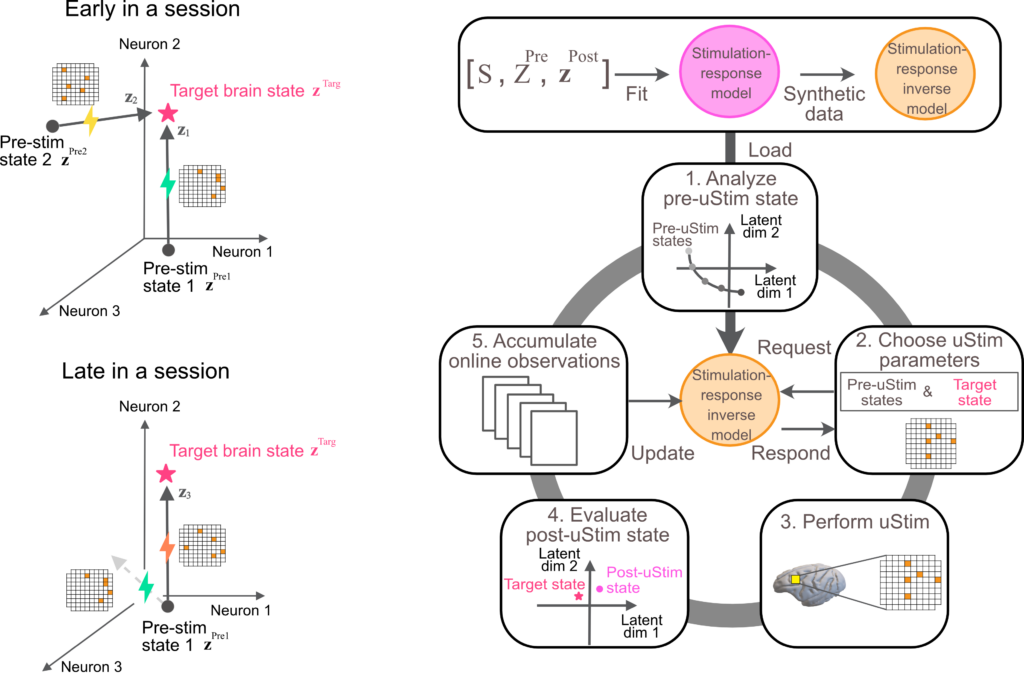
To improve the accuracy by which one can manipulate neural activity, it is important to (1) take into account the pre-stimulation brain state, which can influence the brain’s response to stimulation, and (2) adaptively update stimulation parameters over time to compensate for changes in the brain’s response to stimulation. In this work, we propose Online MicroStimulation Optimization (OMiSO), a brain stimulation framework that leverages brain state information to find stimulation parameters that can drive neural population activity toward specified states. OMiSO includes two key advances: i) training a stimulation- response model that leverages the pre-stimulation brain state, and inverting this model to choose the stimulation parameters, and ii) updating this inverse model online using newly-observed responses to stimulation. OMiSO provides greater accuracy in achieving specified activity states than MiSO, thereby advancing neuromodulation technologies for understanding the brain and for treating brain disorders.
MiSO (Sep 2021 – May 2024)
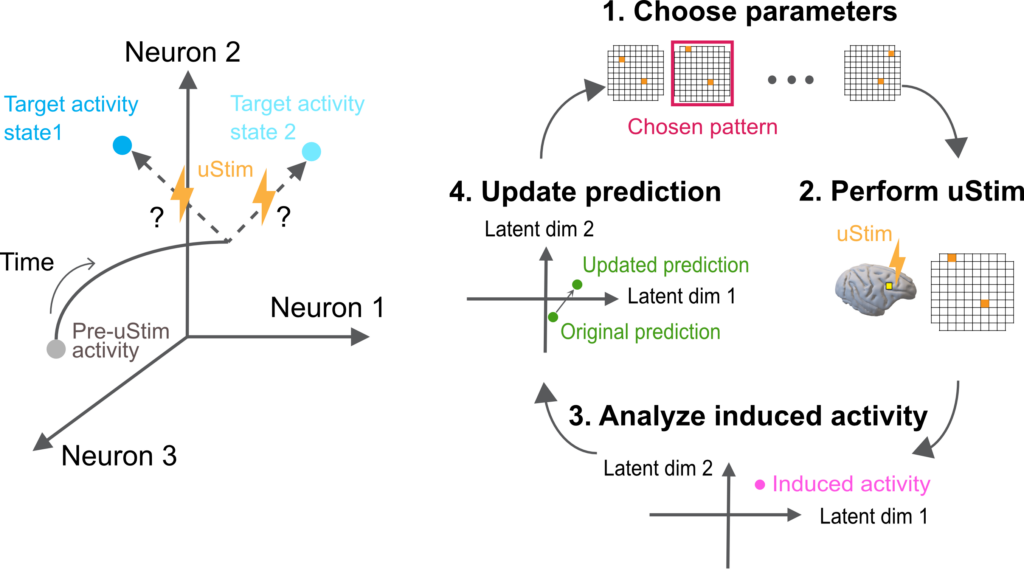
Brain stimulation has the potential to create desired neural population activity states. However, it is challenging to search the large space of stimulation parameters, for example, selecting which subset of electrodes to be used for stimulation. To address this challenge, we develop MiSO (MicroStimulation Optimization), a closed-loop stimulation framework to drive neural population activity toward specified states by optimizing over a large stimulation parameter space. MiSO consists of three key components: 1) a neural activity alignment method to merge stimulation-response samples across sessions, 2) a statistical model trained on the merged samples to predict the brain’s response to untested stimulation parameter configurations, and 3) an online optimization algorithm to adaptively update the stimulation parameter configuration based on the model’s predictions. MiSO increases the clinical viability of neuromodulation technologies by enabling the use of many-fold larger stimulation parameter spaces.
Reveal a monkey’s ability for prospective thinking in solving a maze game (Sep 2019 – May 2021)
The decision-making process is closely interrelated with the process of learning. Monkeys are frequently employed as subjects in scientific research about learning and decision making due to their capability to engage in comparatively intricate tasks compared to other animal subjects. In this study, I evaluated their ability to make prospective decisions through forward thinking by developing a novel maze task.